Home › Services
Tree removal in Spartanburg SC, from the first hard look to the last log hauled off
Taking a tree down is permanent, so the decision deserves more care than the cutting. Across Spartanburg County, the trees that land on removal lists tend to be tall loblolly pines tipping toward a roof, oaks gone hollow at the base, Bradford pears splitting down the middle, and hardwoods that never recovered from drought or a backhoe slicing through their roots. This page covers the warning signs, when a tree can still be kept, how a crew takes a big tree apart in a cramped yard, and what belongs on a written quote. Want a second set of eyes on one particular tree? Post its location and a handful of pictures on the contact page.
Signs a tree in your yard has reached the point of removal
Most trees announce trouble before they fail, but the clues often sit at the base or high in the crown where nobody looks. Two or three of these together usually mean an arborist should see the tree before the next storm season:
- Big limbs with no leaves in midsummer, or bark sloughing off in sheets.
- Mushrooms or shelf-shaped fungal conks on the trunk or root flare, which signal internal decay far larger than the visible growth.
- Vertical cracks in the trunk, or a split running down from a fork where two big stems meet.
- Soil heaving or cracking on the side opposite a lean, meaning the root plate is lifting.
- A lean that has recently changed, as opposed to a gentle angle the tree has held for decades.
- Cavities, soft punky wood, or carpenter ants traveling in and out of the trunk.
- On pines, popcorn-like blobs of resin on the bark, fine sawdust in the crevices, and needles fading to rusty red.
- Heavy root loss from trenching, a new driveway, or fill dirt piled over the root zone.
When a struggling tree can still be saved instead of cut down
Removal is the right answer less often than people expect. A tree with one dead leader or a lopsided crown can frequently be corrected with targeted pruning, which is explained on the tree trimming page. Some weak forks can be supported with cables or rods installed in the upper canopy to limit how far the stems spread apart under wind.
The decision usually goes the other way when decay has hollowed much of the trunk wall, the root plate is lifting, most of the live crown is gone, or the species has a habit of failing at size. Bradford pears are the local example: their tight upright forks split once the tree gets large, and pruning only delays it.
Why Upstate soil, pines and weather put certain trees on the list
Piedmont red clay holds water after long rains and bakes hard in dry spells. Saturated clay loses its grip, which is why tall pines and shallow-rooted hardwoods tend to go over in summer thunderstorms that follow a wet week. Ice storms load every twig at once, and hurricane remnants have toppled large numbers of Upstate trees in recent years.
A loblolly or shortleaf pine weakened by drought is an easy target for bark beetles, and a beetle-killed pine dries and turns brittle fast, so a dead pine near a house is more urgent than a dead oak of similar size. If a tree has already come down on something, see the emergency tree service page.
Rigging and sectional removal for trees standing close to the house
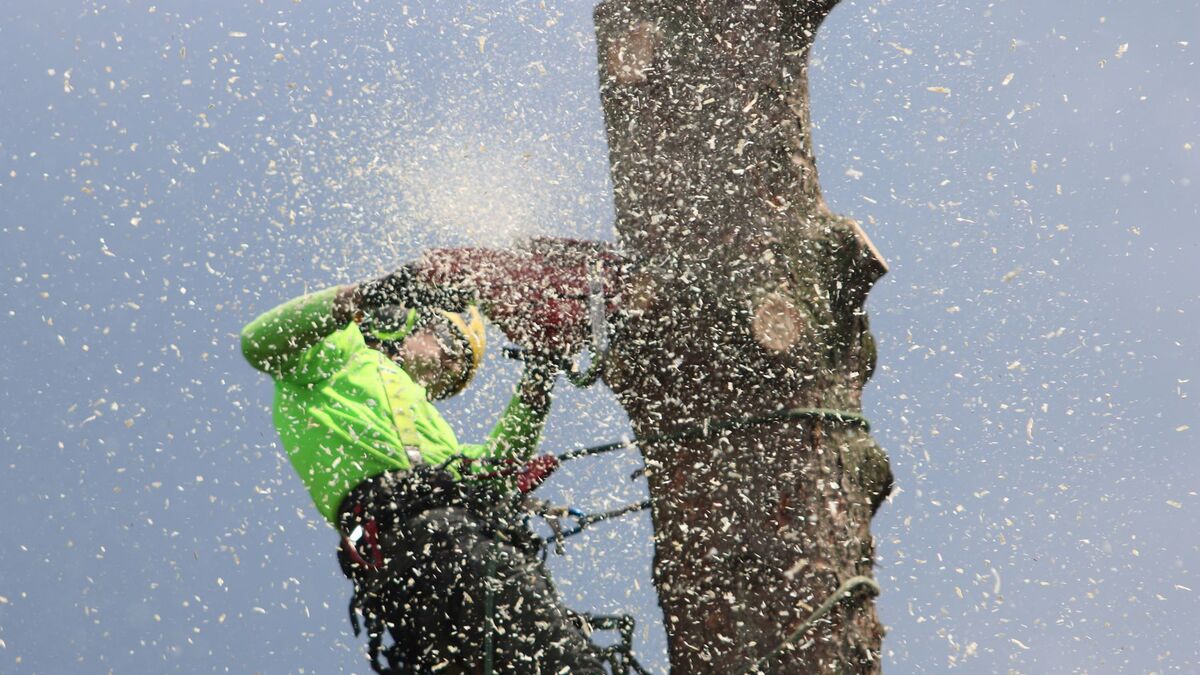
Most residential removals in Spartanburg County cannot be dropped in one piece because a house, fence or neighbor's yard sits within reach. Instead the tree comes down from the top in sections, each one lowered on rope. It is slower than felling, and it is why two trees of similar size can be priced very differently. The usual sequence:
- The crew walks the site, notes every target, and plans where wood will be lowered, piled and chipped.
- A climber or lift operator sets a rigging point high in a sound part of the tree.
- Limbs come off from the outside in, each tied off and let down under control by a ground worker running the rope through a friction device.
- With the crown cleared, the trunk is taken down in pieces sized to what the rigging and the ground below can handle.
- The final section is cut near ground level at the stump height you agreed on.
- Brush goes through the chipper, wood is cut to length, and the yard is raked and blown off.
When a crane is the right tool for a tree removal
A crane lifts large sections straight up and over the house instead of lowering small pieces on rope. It earns its place when a tree is too dead or decayed to climb safely, when it hangs over the roof with nowhere to lower wood, or when the yard has no room for long rigging. The hourly cost is higher, but a day of rigging can shrink to a few hours.
Access decides it. The truck needs a firm, level spot for its outriggers and clear overhead space away from wires, and wet clay can rule out the lawn. Ask where the crane will sit and what goes under the outriggers.
Felling a whole tree when there is open ground around it
On acreage and field edges around Inman, Chesnee and Woodruff, many trees have room to come down in one piece, which is faster and usually less costly. The crew weighs lean, crown weight, wind and trunk decay before choosing a direction, and dead pines or hollow hardwoods are poor candidates because rotten wood behaves unpredictably. Keep people, pets and vehicles well back until the crew says it is clear.
Trees near power lines, service drops and other utilities
Only utility-qualified line clearance crews work near energized lines. A tree touching the main lines along the road is the utility's job, and Duke Energy, which serves much of the Spartanburg area, maintains clearance around its own lines. No general tree contractor should promise to cut into a tree in contact with a live primary line.
The service drop running from the pole to your house is different. The utility can often disconnect it temporarily so a crew can work safely, and that is arranged before the work date. Never touch a tree or limb resting on any wire.
City rules, HOA approvals and trees you may need permission to remove
Some South Carolina municipalities regulate removal of large trees, trees in a street right of way, or trees on commercial property, and rules differ between cities and unincorporated county land. Check with the office that covers the address before scheduling.
Associations are often stricter. Many neighborhoods around Boiling Springs and Duncan require a request before a tree comes down, and some require replanting. A boundary tree deserves a talk with the neighbor first. A written condition note from the contractor helps when an association wants a reason.
Cleanup, chipping and what happens to the wood and debris
Cleanup is where removal quotes differ most. Brush is almost always chipped on site, but you can usually decide how much of the trunk wood leaves:
- Full haul-away: brush, chips and logs all leave, and the yard is raked and blown clean.
- Chips left on site: a pile of fresh chips for mulching beds or paths, which also trims hauling.
- Firewood length: hardwood trunks cut and stacked where you want them. Pine burns poorly indoors, so most owners skip keeping it.
- Logs left whole: on acreage, long sections can rest at a field edge to rot down.
- Stump left in place: it is cut low but stays unless grinding is added, which the stump grinding page explains.
What drives the cost of taking a tree down
There is no honest flat rate, because the same tree can be quick in an open backyard or a full day of rigging over a slate roof. The contractor prices the job after seeing it. The factors that move the number:
- Height, trunk thickness and crown spread.
- What sits underneath: roofs, decks, pools, fences, gardens and the neighbor's property.
- Wood condition, since dead or decayed trees may call for a lift or crane.
- Equipment access, including gate widths, slopes, soft ground and distance from the street.
- Nearby wires and any utility coordination.
- How much debris is hauled, and whether stump grinding is included.
- The number of trees, since several removals in one visit spread out setup time.
What a complete written removal quote should spell out
A quote that lists only a tree and a total invites disagreement on work day. Before signing, confirm the written scope covers:
- Which trees are coming down, identified by location or a mark on the trunk.
- The expected method: climbing and rigging, a lift, a crane or straight felling.
- How lawn, beds and hardscape will be protected, and who handles any damage.
- Stump height, and whether grinding is part of the price.
- Exactly what happens to brush, chips and logs.
- Whether permits, HOA approval or utility coordination are needed, and who arranges them.
- Workmanship coverage terms and how payment is handled.
Getting your property ready before removal day
Move vehicles away from the drop area, bring in patio furniture and planters, and keep children and pets inside during the work. Flag sprinkler heads, invisible fence lines and landscape lighting, and ask whether ground mats will protect the lawn, since soft clay ruts easily after rain. A heads-up to neighbors helps when a truck will park on the street. The same process applies across the communities on the service areas page, and you can get started on the contact page with the address and photos from a few angles.
Tree removal in Spartanburg SC — common questions
Do I need permission to cut down a tree on my own property in Spartanburg?
It depends on the location and the tree. Many owners can remove a tree from a residential lot without a permit, but some cities regulate larger trees, street trees or commercial removals, and the rules vary across the county. Homeowners associations frequently add their own approval step. A quick check with the city or county office for your address, and with your association, settles it before work is scheduled.
How can I tell if my pine tree is dying from beetles?
Check the bark and needles together. Beetle attacks leave pinkish or white globs of hardened resin on the trunk, reddish dust in the bark crevices and tiny exit holes. The crown fades from green to yellow to reddish brown, sometimes within weeks in hot weather. Once the whole crown has turned, the tree is generally dead, and nearby pines deserve a closer look as well.
Will removing a big tree tear up my lawn?
Some wear is normal, but deep ruts are usually avoidable. Damage comes mostly from wheeled equipment crossing wet clay and heavy trunk sections hitting the ground. Crews limit it by lowering wood on rope, landing pieces on brush or mats, parking the chipper on the street, and waiting for dry ground when possible. Ask beforehand whether raking and filling any marks is part of cleanup.
Can a leaning tree be pulled back upright instead of removed?
A young tree tipped by a storm can sometimes be straightened and staked if its roots are mostly intact. A mature tree that has shifted at the root plate has usually torn anchoring roots on one side, and pulling it back does not repair them. A tree that has held the same lean for decades with no fresh soil movement may be stable. The change in angle matters more than the angle itself.
Who takes down a tree that is touching power lines?
When the tree contacts the main lines along the road, the utility handles it with its own qualified crews. Report it right away and keep everyone clear of the tree and anything it touches, including fences and wet ground. If only the service line to your house is involved, a tree contractor can often do the work once the utility has disconnected that line.
Is the stump removed when a tree is cut down?
Not automatically. A standard removal leaves the stump cut fairly low, and getting rid of it is a separate line item. Many owners add grinding during the same visit, while others leave a stump in a wooded corner to rot. If you want the spot ready for grass, a planting bed or a new tree, say so when requesting the quote so the price covers the whole job.
How long does it take to remove a large tree from a residential yard?
An open-ground tree with easy access can be down and cleaned up in a few hours. A tall oak or pine over a house, taken apart piece by piece, can fill most of a day or more, and crane work depends on the crane's schedule and dry ground. Wood haul-off, stump work and the number of trees add time, so the contractor estimates after seeing the site.
Talk through your site
Start with the address, what you want done, and a few photographs of the area, including anywhere water sits after a heavy rain.
Related work
Tree Trimming
Pruning for clearance, structure and storm resistance, done to good arboricultural practice instead of topping.
Stump Grinding
Grinding stumps and surface roots below grade, cleanup of the grindings and what to plant afterward.
Emergency Tree Service
Trees on houses, cars and driveways after storms and ice, made safe first and cleared after.
Land Clearing
Lot and acreage clearing for building pads, driveways, pasture and overgrown property.
Across the metro
Boiling Springs
Fast-growing north-side subdivisions with young pines, hardwood lots and new construction clearing.
Inman
Rolling country and orchard land toward the foothills with big hardwoods and long property lines.
Duncan
West-side growth along I-85 with new neighborhoods, field-edge trees and lot clearing.
Roebuck
South-side rural and suburban lots with mature oaks, pines and storm-prone tree lines.